Sleeper Cell Report September 2025 – Number of ISIS attacks in NES rises for fourth month in a row

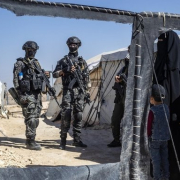
SDF soldiers with the captured ISIS explosives expert Hassan Jafli (photo via SDF Press Office)
Key Points:
- 30 sleeper cell attacks killed 15 military personnel and three civilians, injuring a further 14 military personnel and two civilians
- 66% of attacks concentrated in Deir ez-Zor canton
- 54 arrests of suspected ISIS members
- Child killed by ISIS landmine left behind by Caliphate’s occupation
- UN conference on al-Hol camp calls for states to speed up repatriations
- Iraq announces its intention to repatriate all foreign nationals from al-Hol and Roj camps by the end of the year
In Depth
The beginning of September saw several arrests around Raqqa. Senior ISIS leader Ahmad al-Mahmoud, also known as Abu Mansour, was detained in a joint operation between the Syrian Defence Forces (SDF) and US-led Coalition in Raqqa. A further five arrests were made near Kasrat, south of Raqqa two days later by the SDF.
Two weeks later on September 13, the SDF announced the capture of a senior ISIS member and explosives expert Hassan Jafli, also known as Abu Abdo, in Raqqa. Jafli had been producing TNT explosives and distributing them to ISIS sleeper cells for attacks. The SDF said they had seized 180 TNT blocks, detonators, control devices, electronic circuits, as well as mobile devices and “significant sums of money” in the raid.
Throughout September, the SDF, Internal Security Forces (Asayish) and the Coalition made raids mostly in the Raqqa and Deir ez-Zor cantons leading to a total of 54 arrests of suspected ISIS members in North and East Syria (NES). One civilian was killed in the countryside of Deir ez-Zor after refusing to stop at an SDF checkpoint, leading the SDF to suspect them of belonging to ISIS. A short chase ensued in which an SDF soldier shot the civilian.

Seized TNT, money and electrical devices from Hassan Jafli’s hideout (photo via SDF Press Office)
September saw a series of largely unsuccessful attacks focused in the Deir ez-Zor region by ISIS cells often using motorbikes and small arms targeting military checkpoints, patrols and civilians refusing to pay Zakat to ISIS. On September 25 however, an ambush on an SDF convoy in al-Bahrah, eastern Deir ez-Zor, left five SDF soldiers dead and another wounded. Later in the day, a further four SDF soldiers were killed in an ISIS attack in the village of Burayha, an hour north of al-Bahrah. In total, ISIS attacks in September claimed the lives of 15 and the injury of a further 14 military personnel.
Attacks against civilians were carried out under the pretext of citizens refusing to pay Zakat, an Islamic tax, including attacks against four oil tankers, leading to the injury of two civilians and the death of three. Elsewhere, in the Jazira Canton a child, Saeed Talib Al-Ghadir, was killed by a landmine left behind by ISIS’ occupation near the village of al-Thalja.
In al-Hol camp, the Asayish foiled an escape attempt by 56 women and children on September 2. Three days later, Asayish supported by the Women’s Protection Units (YPJ) and SDF carried out a sweep of the camp targeting ISIS cells within the camp organising attacks and recruiting young people to the so-called Cubs of the Caliphate. A statement from the Asayish explained that recent months had seen an “an escalation in attacks by ISIS cells, as they carried out thirty attacks targeting humanitarian workers and led to the sabotage of facilities.” The one-day operation led to the arrest of eleven suspected ISIS members and seizure of weapons and explosives. This month three Asayish were shot in an ambush in al-Hol camp, killing one of them, sources close to the camp confirmed to RIC.

The operation last month in al-Hol camp (photo via North Press Agency)
With future funding of the al-Hol and Roj camps uncertain under the Trump presidency, officials have been calling on states to conclude repatriations of foreign nationals held in camps and prisons in NES. On September 26 during the United Nations General Assembly, the government of Iraq and the UN Office of Counter-Terrorism held the High Level International Conference on the Repatriation of Persons from Al-Hol, Surrounding Camps and Places of Detention in New York City. The conference gathered UN Member States, UN Agencies and representatives from civil society organisations and NGOs. Discussions focused on repatriation, prosecution, rehabilitation, and reintegration of foreign nationals. Admiral Brad Cooper of US Central Command called on states to accelerate the repatriation process to undermine any ISIS resurgence in the region and announced a ‘Joint Repatriation Cell’ to facilitate the return of displaced persons and detainees. The Democratic Autonomous Administration of North and East Syria, which was excluded from the conference, welcomed these calls in a statement that evening and urged countries to join repatriation efforts.
Ahead of the conference, the Iraqi Government announced plans to repatriate all Iraqi citizens from al-Hol camp by the end of the year and France repatriated three women and ten children. The children have been placed into care whilst two of the women were taken into police custody and the third faces possible indictment by French authorities.
The Australian Government came under fire for allowing two women linked to ISIS and their four children to escape Syria and make their way back to Australia after being detained in Lebanon and then issued passports by the Australian Embassy in Beirut. The Australian Government denied offering any assistance but said they expect more people to follow in the future.
Finally, the Pentagon announced on September 30 that the United States – and other countries it has partnered with in the Coalition to fight ISIS – will decrease their military presence in Iraq after deeming their ISIS counter-insurgency efforts there successful. USA Today reported that remaining forces will be concentrated around Erbil in Iraq and refocused to support efforts fighting ISIS in NES.