
Explainer: What is happening in Sheikh Maqsoud and Ashrafiyeh?
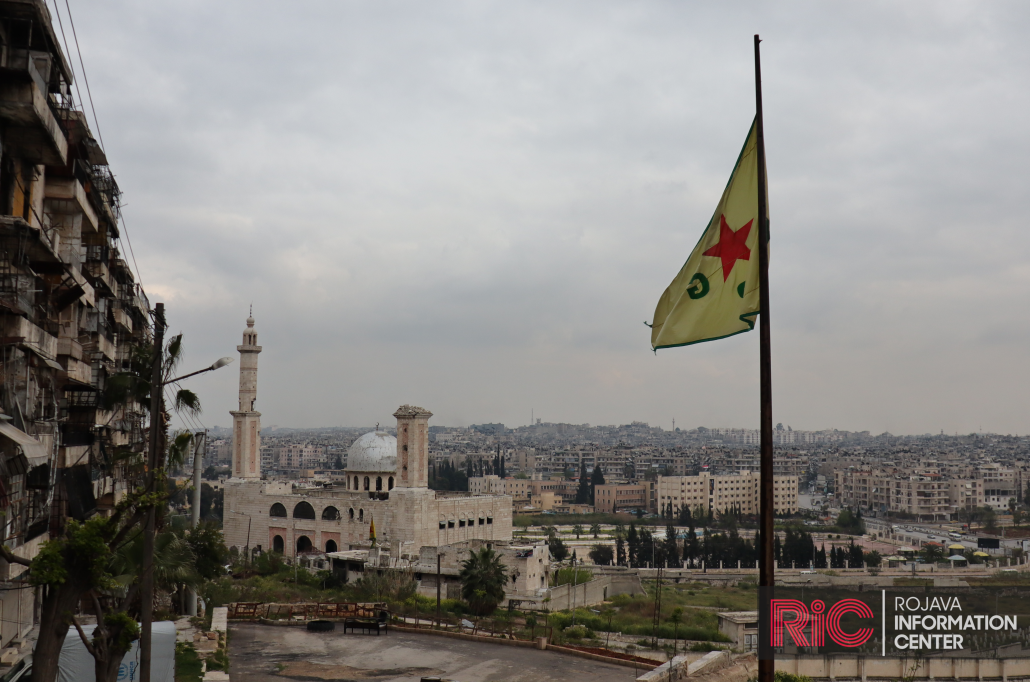

A YPG flag flies over Sheikh Maqsoud in 2021.
Background:
From 2015, the neighborhoods of Sheikh Maqsoud and Ashrafiyeh in Aleppo were governed by the Democratic Autonomous Administration of North and East Syria. The people there self-governed under a model of local governance, marked by a degree of relative autonomy from the rest of Aleppo. This autonomy came to an end in early January when soldiers from the Syrian Transitional Government (STG) attacked and took control of the neighborhoods.
This explainer will explore different aspects of civilian life in Sheikh Maqsoud and Ashrafiyeh and changes that have taken place following the attacks by Syrian government forces and the subsequent control of these neighborhoods by government security forces.
The situation in Sheikh Maqsoud and Ashrafiyeh now:
- Security
While active combat operations ceased in Aleppo after January 11, residents continue to report a lack of security and stability.
Following the withdrawal of the Asayish, government forces were deployed extensively throughout the neighborhoods. Fixed and mobile checkpoints have been established, accompanied by routine inspections of cars and identity checks. Cases of individual arrests were also reported. It is worth noting that none of the civilians Rojava Information Center (RIC) spoke to for this article wished to be named due to fear of reprisals. One civilian told RIC “there were a lot of checkpoints in Aleppo and on the Tabqa road after the war. A lot of people, especially men that were working with the Asayish, have been arrested by the government. Sometimes people, like my cousin, were arrested even when they were not [working with the Asayish].”
During Newroz celebrations on March 21, there were disturbances around the Kurdish areas formerly held by DAANES, including Kobane, Qamishlo and Afrin. In al-Firdaus neighborhood, Aleppo, a video posted online showed two individuals removing the Kurdish flag from one of the vehicles during Newroz.
While segments of the Kurdish population viewed the permission to celebrate as a sign of de-escalation, the accompanying tensions highlighted the fragility of the current situation. Many people still fear the sort of attacks on Kurdish people that happened against Druze and Alawite people last year. This fear is particularly present in Sheikh Maqsoud and Ashrafiyeh where the SDF has not been able to maintain a military presence and Asayish have been totally dissolved, leaving citizens there without strong defenses against any further attacks.
- Infrastructure and Damage
The attacks on Sheikh Maqsoud involved shelling, drone attacks and airstrikes on the densely populated neighborhoods. Many residential buildings and civilian infrastructure such as the Khaled Fajr Hospital were heavily damaged by the fighting. Aerial footage from Al Jazeera shows some of the extent of this damage.
After the fighting, the main roads were gradually reopened. However, no organized reconstruction initiatives have been reported. Limited cleanup efforts by local residents and the Aleppo municipality have been observed but improvements have largely been restricted to the removal of bodies, rubble and debris. So far, there has been no sign of the government funding any reconstruction projects.
Prior to the assault in January, Sheikh Maqsoud had been under an intermittent siege with access to food, water, fuel and electricity restricted from July. There has been a partial improvement with regards to electricity, but residents still experience periodic outages and prices have risen significantly. Syrian electricity costs have increased significantly in the past year. According to The National, households will now pay about 600 Syrian pounds ($0.052) per KWH – or about $15 every two months. It is a dramatic increase from the previous rate of nine Syrian pounds per kilowatt hour, or a total of $0.27 per billing period. The residents of Sheikh Maqsoud and Ashrafiyeh are now subject to these price increases, too. As in the rest of Syria, the rise in prices for electricity, gas and oil has been compounded by the shortages experienced globally due to the war in Iran.
One civilian in Sheikh Maqsoud said, “Before, the autonomous administration was providing the neighborhoods with electricity from diesel generators but after the government came many people stopped buying this electricity from the generators because the price rose two to three times higher than before. The diesel and gasoline has become too expensive so now we use the mains electricity from the government which is good on some days but on other days there are outages. We haven’t paid yet because the new government hasn’t checked the meter but in the other cities the price for one month was unbelievable.” The civilian added that water availability is irregular, although better than electricity and still comes at least once a day.
- Local economy
The area has experienced a noticeable rise in prices for essential commodities like fuel and food. Some items like bread and tomatoes have doubled in price. This has been compounded by a lack of job opportunities, and an unprecedented increase in unemployment. The DAANES provided jobs for many residents through the internal security forces (Asayish), communes, schools and supported small businesses and cooperatives in Sheikh Maqsoud including a clothes factory, cafes and grocery shops with subsidies. Without the administration and its subsidies or direct employment, many people have become unemployed. Purchasing power has significantly declined, and the overall economic situation remains fragile.
This unemployment has made recovery after the attacks more difficult, with many unable to repair their damaged homes. One civilian said, “after the war, some people were able to fix their damaged things but there are those who weren’t able to because of the unemployment and rise in prices. So far the government hasn’t offered any help to the residents.”
- Return of internally displaced people (IDPs)
There has historically been a large Afrini population in Aleppo due to Afrinis travelling for work or study. Many settled there and in 2018 as a result of the Turkish invasion and occupation of Afrin, more found themselves displaced to Aleppo. In 2024 when Assad fell, thousands of IDPs were displaced from nearby Shehba to Aleppo.
During January’s assault on the autonomous neighborhoods, an estimated 148,000 people fled. There has been a gradual return of residents, though partial displacement persists. According to a civilian who spoke to RIC, return is hindered by several factors, including partially destroyed homes, security concerns, and economic instability. Many IDPs remain displaced and return is largely dependent on individual family circumstances.
Other refugees have opted to return to Afrin but this has its own difficulties as many Afrini homes are still occupied by Arab settlers. Another civilian told RIC, “A lot of people when they first came back to Aleppo fixed the damaged houses and stayed there because they didn’t have another one. For some people Aleppo was their home but after Sheikh Maqsoud we returned to Afrin. Now I’m in Afrin staying with my uncle because some Arab family is staying in my [Afrin] home but they said they are going to leave this week. I hope so.”
- Detainees and Casualties:
At the time of writing, no comprehensive numbers are available regarding casualties and detainees from the attacks on Sheikh Maqsoud and Ashrafiyeh. According to estimates reported by various sources such as SANA and Sky News, the approximate number of fatalities ranges between 24 and 45 however RIC believes this number to be significantly higher.
During and immediately after the fighting, at least 300 people were detained. Since the ceasefire agreement came into place in February, around 1000 civilian and SDF prisoners that had been captured across NES in January’s fighting were released alongside prisoners from earlier Turkish invasions of Afrin and Serekaniye. An unknown number of prisoners, including some confirmed Asayish fighters from Sheikh Maqsoud, remain in the hands of Damascus and many are unaccounted for, raising significant concerns among families regarding their fate. It is also unclear how many people have been arrested in Sheikh Maqsoud in the months following the ceasefire agreement and whether they have been imprisoned too.
Conclusion
The end of military confrontations and takeover of Sheikh Maqsoud and Ashrafiyeh by the STG has not led to comprehensive stability and improved living conditions for residents. This cannot be considered the end of a crisis, but rather its transformation into a new phase, the contours of which are still taking shape.
Despite a relative level of security, calm and a partial return to daily life, reflecting the situation in Syria more broadly, root structural challenges remain unaddressed and indicators of fragility are evident across the economy and social life. Persistent economic pressures, lack of trust, and underlying tensions continue to shape the local reality.
The STG is facing many challenges after taking control of Sheikh Maqsoud and Ashrafiyeh. In 2025, after 14 years of war, the World Bank estimated the cost of rebuilding Syria at over $200bn. In Aleppo, the STG now must rebuild the infrastructure and housing they destroyed in January, on top of reconstruction efforts in the rest of Syria. The STG must tackle challenges facing the local economy. Where before DAANES helped stimulate economic activity and employment, the void created by their integration into the Syrian state has created high unemployment in Sheikh Maqsoud and Ashrafiyeh. This has made the rise in food, gas and oil prices that those living under the Autonomous Administration were previously sheltered from much harder to meet.
Another challenge is ongoing security concerns. Whilst the multiethnic society in NES strived to create peaceful coexistence between the many ethnic and religious groups in Syria, this is now under threat with the arrival of the Damascus government. The Kurdish and Christian populations in Sheikh Maqsoud and Ashrafiyeh are concerned that they could face the same sectarian violence that has been directed towards Druze, Alawite and Christian communities in the rest of Syria. Ensuring that this isolated enclave does not see further violence is another challenge facing the government. The future of the neighborhood depends largely on the ability of Damascus to move beyond a security-based approach toward sustainable stability grounded in improved living conditions and strengthened community trust.