
ISIS Escapes as a Result of Syrian Army Assault
ISIS Escapes as a Result of Syrian Army Assault
The recent assault by Syrian army forces on the Democratic Autonomous Administration of North and East Syria (DAANES) has led to a widespread breakdown in ISIS detention facilities. Flanked by government security forces in Tabqa, Mohamed Belaa, a journalist on a ride-along with the advancing Syrian army, declared releasing prisoners “a noble goal and a priority for us.” RIC has identified at least six sites in which detainees were released by Syrian forces or armed forces operating in close coordination with Damascus. Of these, four were confirmed to house ISIS members, whereas the nature of the other two prisons remains unverified. The four sites housed an estimated 33,500 ISIS members altogether. It is unclear how many of these managed to escape, and where they have gone to. Yet already, Iraq’s Popular Mobilization Forces (PMF) reported capturing Mahmoud Hassan al-Jubouri, whom they describe as “a prominent ISIS leader”, while he was attempting to cross into Iraq from Syria.
Despite repeated accusations that the Syrian Defence Forces (SDF) were releasing its own detainees, video evidence showed men with strong suspected ties to the Damascus government liberating prisoners. In at least two cases – the 17th Division prison in Raqqa and al-Hol camp – the presence of Syrian army soldiers is clearly visible. Notably, an ISIS patch is visible on at least one soldier participating in the operation against the DAANES, as seen on an Al-Jazeera broadcast. According to the SDF, on January 19, a group of their soldiers was beheaded and filmed “in the style of the ISIS terrorist organization” by Syrian army soldiers.
Around 3 PM (local time) on January 18, 2026, videos posted on X showed men allegedly liberated from al-Ma’amel Prison in Deir ez-Zor. An accompanying description by BasNews, a Kurdish-language news channel based in Erbil, said “dozens” of ISIS prisoners had been released at this site after the SDF withdrew. In the video, the men can be heard identifying themselves as belonging to tribes and the Free Syrian Army (FSA). However, according to Amnesty International, the facility is also used to hold men accused of having an ISIS affiliation.
That same afternoon, journalist Wladimir van Wilgenburg repoted that a pro-ISIS account shared the message on Facebook: “Make sure, brothers, that all the sisters have been released from the Tameer prison in Raqqa. Praise be to God, Lord of the Worlds.” According to British security analyst Darren White, ISIS channels have given the liberation of women at Tameer prison particular attention. Shortly thereafter, videos of women detainees escaping said prison emerged online. According to one commentator, some 3,000 ISIS-linked women were released by STG, though RIC could not independently verify that claim. A video from inside the prison shows two men aiding in the escape.
Al-Aqtan prison, northeast of Raqqa city, holds around 2,000 male ISIS prisoners. 500 SDF soldiers have defended the prison against repeated Syrian army attacks, seen in videos shared on X, since January 17. In a video released by the soldiers themselves, they say ISIS prisoners breached several gates in parallel with the Syrian army attack. It is unclear whether they coordinated their actions with government troops. In the afternoon of January 19, SDF press spokesperson Farhad Shami said his forces had asked the Coalition to transfer the prisoners to a safe location, though “the Coalition has so far taken no practical steps in this regard.” According to Shami, at least nine SDF soldiers were killed, and 20 injured in repeated attacks on al-Aqtan. Moreover, the Syrian army cut off water supplies to the prison. In the afternoon of January 20, the SDF says the Syrian army once again attempted to breach the prison gates. Pictures shared by SANA show military police surrounding the prison complex at that time. A video shared by SyriaNow shows Syrian government forces releasing prisoners from the SDF’s 17th Division prison, located nearby in Raqqa. The released men can be seen running away after declaring their name and their cities of birth.
In the early morning hours of January 19, Shaddadi prison, south of Heseke, came under attack by government forces. According to Farhad Shami, the SDF repelled several attacks, causing the death of “dozens” of SDF soldiers. The Coalition, despite being present at a base only 2km away, did not intervene. By 5 PM that day, the SDF spokesman stated that the prison had “fallen outside the control of our forces.” Later that day, the SDF shared two videos showing what the SDF said was government forces opening the cells of Shaddadi prison. Shami told Rudaw that 1,500 ISIS militants housed in Shaddadi had been freed. Shortly after 7 PM, the government then announced a total curfew on the town of Shaddadi in order to recapture the prisoners they accused the SDF of freeing.
Simultaneously, SDF soldiers also pulled out of Sini prison, a smaller facility holding ISIS detainees in the outskirts of Shaddadi. The National reported that its 120 prisoners escaped, likely liberated by tribal forces which appeared before government troops. The Syrian government later claimed to have captured 81 out of 120 escapees. It is unclear whether this refers to the same Shaddadi prison.
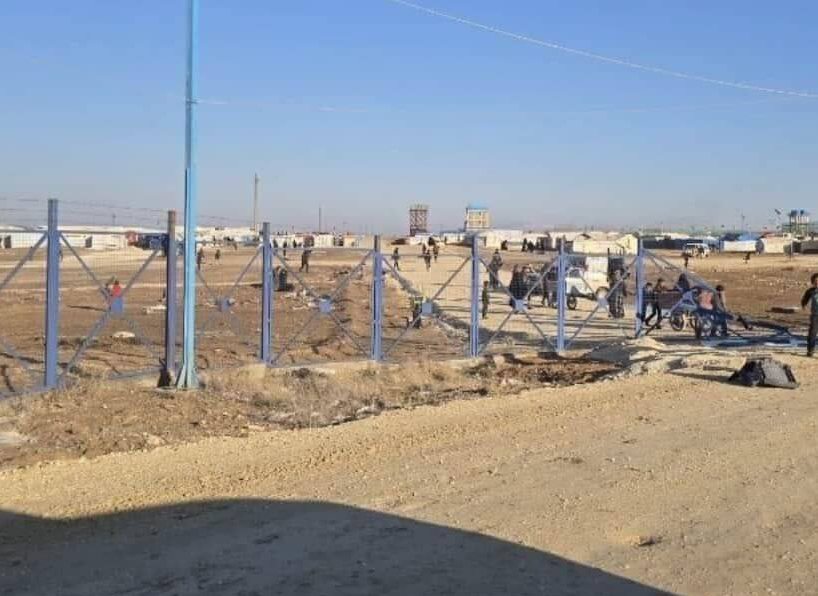
Al-Hol camp is by far the largest detention camp in northeast Syria. It currently holds around 25,000 ISIS linked individuals, down from nearly 80,000 in the aftermath of the SDF’s defeat of the caliphate. Around 7,000 of these are neither Syrian nor Iraqi, but foreign nationals who travelled to join the terror group. Several videos and pictures shared online show detainees breaching the camp perimeter. One video, in particular, shows what appears to be hundreds of detainees exiting the camp. Another video, posted around 5 PM, shows Syrian army vehicles approaching the perimeter of the camp to cheers from within the fence. Pro-ISIS accounts called on residents of the nearby town of al-Hol to reach out to escaping ISIS detainees. At 4 PM, Farhad Shami announced the SDF was leaving the camp “due to the international indifference.” Shortly after, government forces were reportedly in control of the camp. Syria’s Interior Ministry accused the SDF of having set ISIS members free almost immediately. Pictures shared by SANA showed Syrian army soldiers in control of the camp before sundown. SDF forces announced their redeployment to the vicinity of al-Hol an hour later in order to reinforce defensive lines around population centers and prevent potential attacks linked to ISIS cells operating inside and outside the camp. Camp detainees protested on the morning of January 21 for Syrian security forces to let them exit the camp. For a full account of the events on January 20 at al-Hol camp, please see our investigation here.
Many ISIS detention facilities continue to be in the hands of the SDF. If they were to fall into government hands, many thousands more ISIS members could be released. Al-Sina’a Prison in Heseke contains 4,000 ISIS fighters. In 2022, an ISIS prison escape attempt at this site, coordinated between prisoners and outside ISIS cells, killed at least 121 people during a week-long uprising. According to the SDF, the prison already came under attack on January 20, though soldiers repelled the attempted breach. Other sites include the Black Prison in Derik, which held around 2,000 male ISIS fighters in 2022; Alaya Prison in Qamishlo, holding some 1,500 convicted men with ties to ISIS; and Roj camp, near Derik, which is home mostly to 2,100 ISIS-linked women and their children, and at least 50 young men aged 18-20 who grew up there.
Note: This article was originally published at 01:00 on 21.01.2026. Some minor details were then added or updated at 20:00 on the same day and then again on Feb. 11.