
North and East Syria Post-Assad: Challenges and Opportunities
OVERVIEW
Syria stands at a crossroads, One year on since the defeat of Bashar al-Assad and the unexpected rise to power of Ahmed al-Sharaa, the country remains divided between territories under the direct or partial control of the new government in Damascus, and the autonomous polity in North and East Syria (NES). The relationship between NES and Damascus is the principal political question set to determine the direction of the future Syria, with the end of 2025 bringing with it a mooted deadline for the implementation of a crucial but highly-contested agreement between the two authorities. This report assesses the security, political and humanitarian situation in NES as it has evolved throughout the past year, exploring the threats, challenges, openings and opportunities occasioned in NES by the rapid political developments undergone in Syria throughout the past year.
INTRODUCTION: AL-ASSAD’S FALL
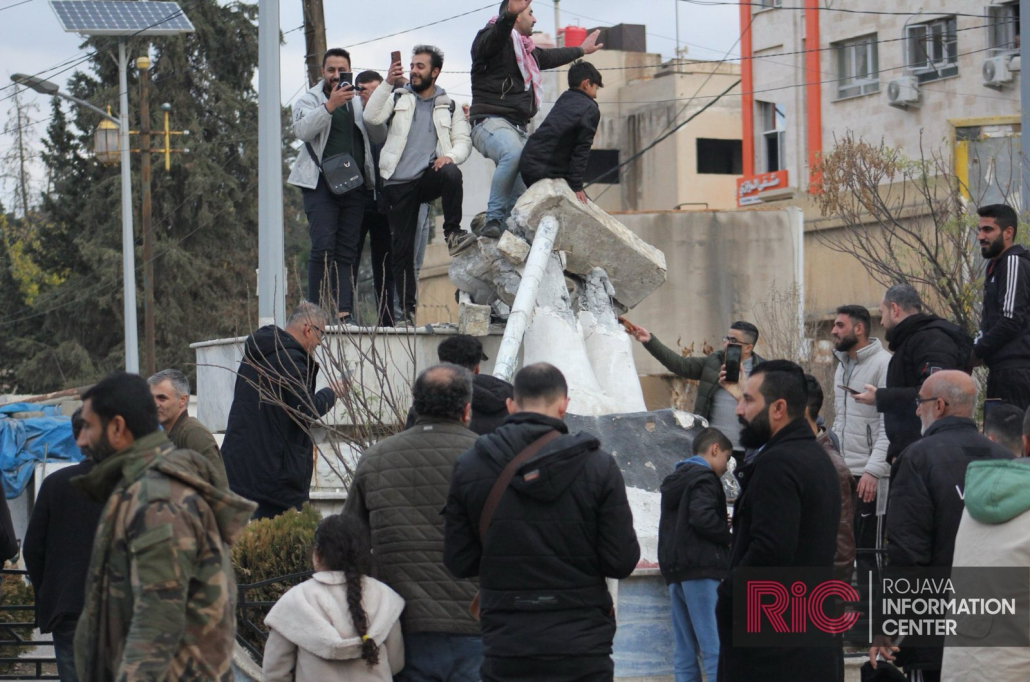
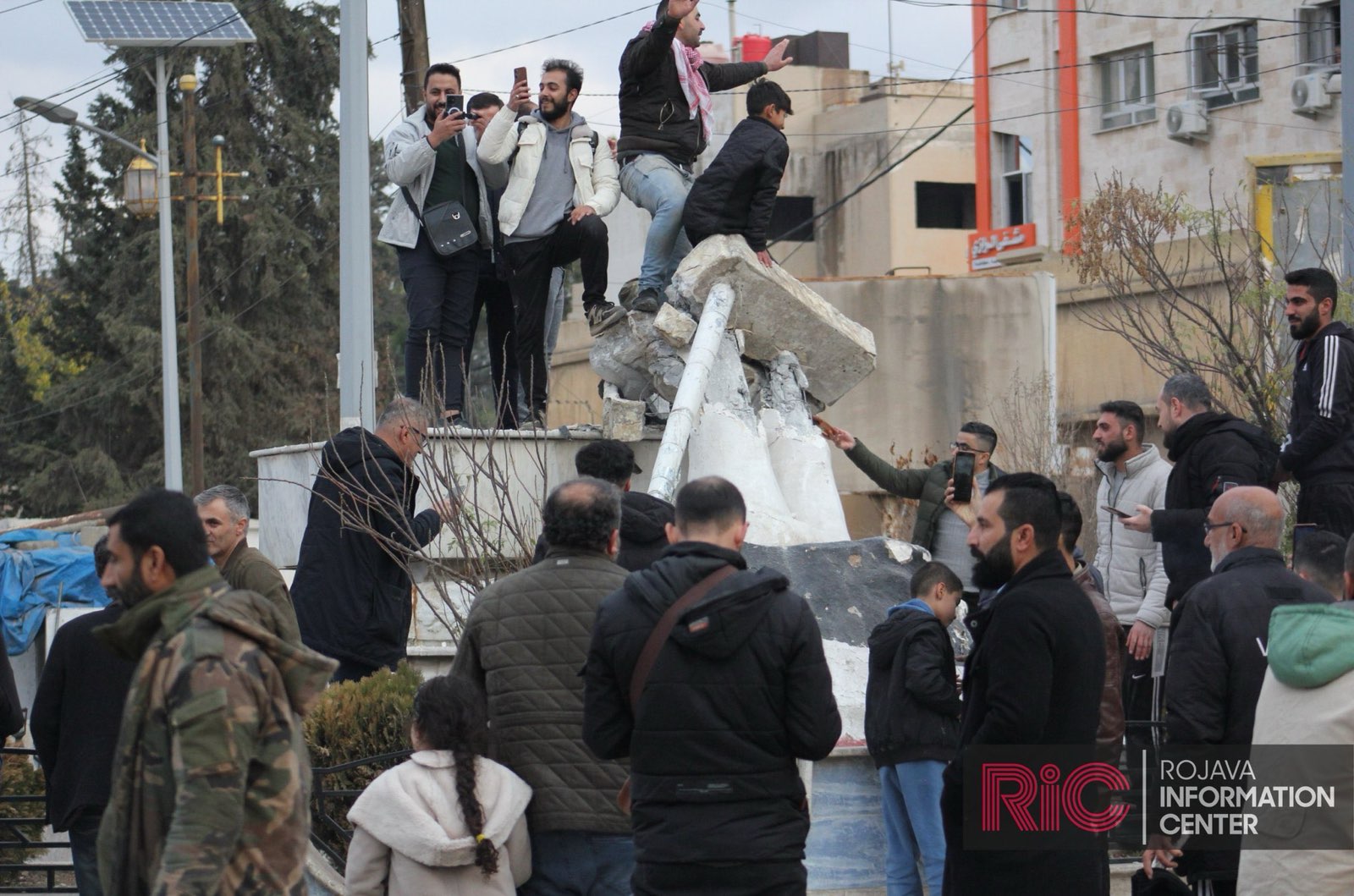
Given their long-term opposition to the centralized and authoritarian government of Bashar al-Assad, political and military authorities in North and East Syria (NES) welcomed the dictator’s December 2024 ouster. As news spread of al-Assad’s defeat in an offensive spearheaded by Hayat Tahrir al-Sham (HTS), the public likewise took to the streets throughout NES to topple statues and celebrate the end of his rule.
However, the same days which saw al-Assad driven from power also witnessed NES facing its first large-scale ground invasion in five years. As HTS began their offensive to take Damascus, the Democratic Autonomous Administration of North and East Syria (DAANES) was dealing with a major humanitarian crisis triggered by the mass displacement of the population of Shehba, as the Turkish-backed Syrian National Army (SNA) militias launched their own offensive targeting NES, rather than al-Assad’s forces. As previously documented by the RIC, these attacks killed scores of civilians including civilians and journalists and medical workers, while resulting in the displacement of up to 100,000 civilians (almost all IDPs) who had been living in the DAANES-run Shehba canton.
Backed by Turkish airpower, the SNA captured all DAANES-held territory to the west of the Euphrates river. Hostilities continued along this new frontline for over 3 months, particularly at the key flashpoint of Tishreen Dam. Twenty-two civilians were killed in Turkish and SNA airstrikes at the dam, while these attacks also cut the power and water supply from hundreds of thousands of civilians in the neighbouring regions around the city of Kobane.
To date, the new authorities in Damascus have avoided direct conflict with NES, as explained in more detail below. Yet on the national level, stability has still eluded Syria, and the balances of power in the country continue to shift. NES faces not only military threats from the Syrian government, the Turkish Armed Forces (TAF), and the SNA, but also the political challenge of integration into a new government ideologically opposed to the DAANES’ stated vision of federalism, pluralism, and women’s and minority rights. Progress on negotiations between NES and Damascus has remained painfully slow and frustrated by external influence, military pressure on NES raises the spectre of sectarian violence like that which has affected other regions of Syria, while the general humanitarian crisis remains acute in NES as throughout Syria.
NES’ military and political representatives have thus sounded a cautious note in their statements marking the first anniversary of the new political order in Syria, calling for the country to continue a transition toward a democratic and inclusive political settlement while recalling the grave challenges faced by their region and Syrians at large throughout the past twelve months.In his statement on the first anniversary of al-Assad’s defeat, Syrian Democratic Forces (SDF) commander-in-chief Mazloum Abdi said: “A year ago, Syria entered a new phase with the fall of the former regime, a pivotal moment we take pride in, which ended decades of tyranny and division.” At the same time, the co-chair of the DAANES’ Foreign Relations Board, Ilham Ahmed, stated that a genuine transition away from al-Assad’s legacy can only be achieved through “good governance, broad public participation, and a meaningful role for women in shaping policies and decisions… This path moves forward through effective domestic political engagement inspired by the goals of the revolution and strengthened by a renewed sense of national partnership.”
Responding to these developments, the RIC published two in-depth reports in the months following al-Assad’s defeat. The first report detailed SNA and Turkish attacks specifically targeting civilians and civilian infrastructure in NES in the aftermath of the fall of al-Assad, while the second gave an account of HTS’ rise to power in Damascus. This brief report assesses subsequent security, political, economic and humanitarian developments affecting NES throughout the year since al-Assad’s defeat, to ask whether the tentative hopes brought about by al-Assad’s defeat can be realised – or whether the threats facing NES will drive Syria further into bloodshed, political fragmentation and humanitarian crisis.
CEASEFIRE AND INTEGRATION?: THE MARCH 10 AGREEMENT
After al-Assad’s fall, HTS chief Ahmed al-Sharaa and his close affiliates in the organization set about consolidating power in Syria. These processes have been marked by the exclusion of millions of civilians living in NES territory, as well as the region’s political representatives. For example, on February 24-25, the Syrian ‘National Dialogue Conference’ was held in Damascus. 600 delegates from across Syria took part but representatives from DAANES were excluded and a range of Syrian civil society actors criticised the conference for not properly representing minorities, among other issues. The conference came together to make proposals for a new constitution, and on March 13 al-Sharaa signed an interim constitution into law which will remain valid for five years. After taking power, al-Sharaa used his first major interview as president to state his opposition to the DAANES’ proposed federal vision for Syria.
NES’ representative body, the Syrian Democratic Council (SDC) declared the constitution “illegitimate” for giving too much power to the President and not recognising the ethnic and religious diversity of Syrians and enshrining their rights. They have demanded minority rights be included in the constitution and further protections for women’s rights. Women’s organizations in NES including Kongra Star and the Zenobia Women’s Association have launched a campaign demanding women be included at every stage of shaping Syria’s future.
Alongside these political tensions, the security situation remained highly volatile. Following their December 2024 capture of NES’ Manbij and Shehba cantons, Turkey and its SNA militias looked poised to continue their military operations east of the Euphrates. Fighting at the crucial Tishreen dam cost hundreds of lives including 73 civilians, but the SNA were not able to continue their advance deeper into SDF-held territory. Turkey did not receive a green light from the US for further operations against NES, with Damascus and the SDF instead opening negotiations under US sponsorship even as hostilities continued at Tishreen and along the Euphrates.
Al-Sharaa met with SDF commander-in-chief Abdi in person for the first time in early January, beginning a series of talks which culminated in a landmark agreement signed between the SDF and Damascus on March 10 2025, announcing a full ceasefire throughout Syria. This agreement had both military and political dimensions, notably calling for “merging all the civil and military institutions in northeast Syria within the Syrian state’s administration, including the border crossings, airport and oil and gas fields.” It also covered formal recognition of the Kurdish people, the rights of Syria’s minority ethnic and religious communities, and the right of return for displaced Syrians. The declaration gave a deadline of the end of 2025 for full-scale integration along these lines.

The agreement was immediately effective in drawing down hostilities at Tishreen and along the Euphrates. Notably, Turkish airstrikes against NES have been totally suspended since the agreement was signed, in a positive development also linked to ongoing peace talks between Turkey and the Kurdistan Workers’ Party (PKK), the militant group which Turkey views as politically and militarily linked to NES.
However, the agreement left unclear how, to what extent, and in what form this proposed political and military integration would take place, and subsequent negotiations between NES and Damascus have been slow and fraught. Meanwhile Turkey, as the key international partner of the new rulers in Damascus (see below), has exerted direct pressure to prevent the negotiations moving forward, notably stepping in to prevent a planned meeting between the two sides in Paris under French sponsorship in August 2025.
Even where discussions have gone ahead, there are a number of key sticking-points between the two sides, including the precise nature of military integration and control of the country’s oil resources.
On the first issue, Damascus has been pushing for individual SDF combatants or units to join a unified armed forces directed by the Syrian Ministry of Defense. For its part, the SDF has stated its desire to integrate but on a less granular level, retaining cohesive, SDF-specific divisions while nonetheless forming part of a unified national military. Ankara remains opposed to the SDF’s proposed vision, notwithstanding the fact that some of the SNA militias have been allowed to formally enter the new Syrian army but remain de facto unchanged as organizational entities, preserving their original leadership structure.
Similarly, whereas Damascus has proposed taking control of all of the region’s oil resources and then apportioning funds to Syria’s various regions, NES’ representatives have advocated for a more decentralized approach in which their region is able to control a portion of the oil revenues in their own right and apportion these within their own regions.
Recently, NES representatives have signalled some progress on the security front, with Abdi using a recent interview to announce: “We have agreed to maintain three divisions of the SDF and two special battalions. One of those would focus on border security, and the other one is the female battalion, and we would all be part of the Ministry of Defense.” A senior SDF commander, Abu Omar al-Idlibi, explained that “this will be carried out according to a mechanism that will be agreed upon, with [implementation] details to be addressed during the successive rounds of negotiations,” adding that the SDF may change its name with this integration. On the question of oil revenues, DAANES representatives have similarly signalled that they are open to a settlement which apportions an overall majority of the oil revenues to and through Damascus, while ringfencing a specific portion of the profits for the north-eastern regions.
Nonetheless, with the mooted deadline of the end of 2025 rapidly approaching, the political and security landscape between NES and Damascus still looks much as it did prior to the March 10 agreement. Sub-committees set up to address other issues including integration of educational curricula and coordination on power and infrastructure have also failed to advance their discussions. Representatives have spoken of a “political freeze” on the negotiations, meaning it remains unclear whether there will be further concrete developments on the ground ahead of the end of 2025 deadline. Rhetoric around a Turkish or Syrian government military offensive against NES therefore remains high, raising the spectre of fresh military operations as the year ends.
POST-MARCH 10: POLITICAL AND MILITARY TENSIONS
These negotiations are not occurring in a vacuum, but in the context of continued military, political and economic tensions between Damascus and NES.
While the March 10 agreement brought an end to Turkish airstrikes, clashes have continued to break out between HTS and SNA-led forces and the SDF, even as fraught negotiations continue over the integration of the SDF into the new Syrian armed forces. This has been particularly true at the key flashpoints of Aleppo city’s DAANES-governed neighbourhoods of Sheikh Maqsoud and Ashrafiyeh, Deir Hafer in the Aleppo countryside, and along the Euphrates River, around both the Tishreen Dam and Deir ez-Zor.
These issues have been compounded by concerns over the make-up of the new Syrian military. As mentioned above, SNA groups notorious for human rights violations like the SNA’s Sultan Suleiman Shah and Hamza divisions have been kept whole and superficially “reflagged” with new names and designations, instead of being broken up and dispersed among new formations in the Syrian military. Meanwhile, two-thirds of the senior commanders in the new Syrian Army are former HTS members.
Targeted violence experienced by the Druze community in Suwayda and Alawite community in Syria’s coastal region at the hands of members of the new Syrian army and General Security forces sparked concerns for Syria’s other minorities including the Kurds, Yazidis and Christians, many of whom reside in NES. SDF representatives have raised questions over the competency of Damascus to prevent sectarian violence like that which has plagued other regions in Syria (see below) from also occurring in NES.
In May 2025, the European Union (EU) imposed sanctions on the aforementioned Suleiman Shah and Hamza SNA factions, plus the Sultan Murad division, as well as Hamza commander Sayf Boulad (aka Abu Bakir) and Suleiman Shah commander Muhammad Hussein al-Jasim (aka Abu Amsha). This came in the context of the factions’ involvement in the anti-Alawite mass killings which occurred along Syria’s coastline in March of that year. The EU sanctions listings cited “horrific crimes committed against civilians in the context of that violence, including arbitrary killings”.
SDF representatives are also concerned about their proposed integration into the Syrian military given the make-up of the emergent military order in Syria, raising particular worries over the fate of SDF’s well-known all-female armed units (Women’s Protection Units, or YPJ). Abdi acknowledged that “there are major challenges in integrating the forces. How can we integrate the female battalion? They [the Syrian government] have no female battalions at all, and we cannot separate our women fighters.”
In a previous interview with RIC, YPJ commander Rohilat Afrin had suggested that the YPJ’s participation in the Syrian army could lay the groundwork for the building of a national women’s army: “If – as the population wishes for and as we wish for – Syria truly becomes a democratic Syria, politically, socially, legally; if all the effort given and achievements gained in NES through the past 12 years are recognized, then of course YPJ can become a part of this army [the Syrian army]. In fact, YPJ can serve as a model for Syrian women, setting an example of women’s autonomy and self-defence. […] If an approach is adopted that embraces diversity and is democratic, then the role of YPJ can be discussed. The composition of a Syrian women’s army can be shaped by the YPJ.”
Yet with Damascus’ approach towards women’s rights a far cry from the progressive model developed in NES, SDF officials are concerned about the transitional government’s willingness to respect the dignity, integrity and autonomy of the YPJ.
Meanwhile the responsibility for ensuring the secure detention of thousands of ISIS affiliates in Syria is currently being shouldered by the SDF, as it has been for the past seven years. While around 10,000 male suspected ISIS fighters are held in prisons and detention centers across NES, ISIS sleeper cell attacks continue, and have even increased in frequency the past year, according to numerous estimates. In June, an ISIS suicide bomb attack on a Greek Orthodox church in Damascus killed 25 Christians. NES has been witnessing smaller IED and hit-and-run style attacks, mainly targeting military checkpoints. “We are still losing soldiers in attacks by ISIS on the SDF in Raqqa, Deir Ezzor, and other areas,” stated Abdi. Yet with the government failing to protect the country’s minorities, and ISIS able to exploit security vacuums to rebuild and reconstitute, there are concerns over the fallout should the SDF transfer responsibility for maintaining ISIS detention facilities to Damascus, as the latter have been pushing for. Even as Syria officially joins the Global Coalition to fight ISIS, new military recruits say the transitional government is prioritising religious instruction and loyalty to al-Sharaa over combat training and discipline, leading to doubts over the competency and professionalism of the new army.

These security challenges are linked to broader questions over Syria’s prospects for national reintegration and post-conflict transition. Al-Sharaa has spoken at length about the end of the Assad era opening new possibilities for displaced Syrians to return home, and expressed optimism that millions of Syrian refugees living abroad would come back within two years.
For Kurdish IDPs from the Turkish-occupied regions of Afrin and Sere Kaniye, however, safe return is still a distinct prospect. In its ‘State of the Occupation’ reports, RIC has tracked the crimes and rights violations committed by the Turkish-backed SNA, that have become commonplace in both Afrin and the region around the cities of Sere Kaniye and Tel Abyad (the ‘M4 Strip’) since 2018 and 2019 respectively, when Turkey invaded and occupied the territories. While much of the population of Kurdish-majority Afrin and Sere Kaniye fled during the invasions, those that chose to remain under Turkish occupation saw their region turn into a patchwork of SNA fiefdoms, where militiamen and settlers from outside the region exploit, extract financial resources from and intimidate the local population.
The March 10 agreement featured an article committing to ensure that all displaced Syrians return to their towns and villages, protected by the Syrian state. Many IDPs from Sere Kaniye and Afrin were hopeful that this signalled a coming end to the occupation of their region, and the chance to return home. “An atmosphere of reassurance was created,” according to Ibrahim Haftaro, a member of the Afrin Association General Council. However, conditions are still not conducive to large-scale safe return and long-term security. While many settlers have departed from Afrin, and some native inhabitants have returned, theft, lawlessness and property destruction remain rampant. Settlers have stripped houses bare before leaving, taking everything of value, such that returnee IDPs find their homes unrecognisable and unlivable.
Former director of the Afrin Human Rights Association, Ibrahim Sheikho, said that while “some [Afrin] residents have gradually returned […] there has been no progress on the ground”. He added that “discussions were had regarding education in Syria”, in reference to a series of NES-Damascus meetings that sought to reach a settlement to enable students to complete their studies and sit their exams. “In contrast, there’s been no discussion on the return of people from Afrin, Sere Kaniye, and Gire Spi [Tel Abyad].”
The aforementioned internationally-sanctioned SNA factions, such as Sultan Suleiman Shah and Hamza, have now become a part of the new Syrian army, and hence are no longer geographically constrained just to their former fiefdoms. This has enabled a slew of fresh violations, including against Kurds from Afrin travelling in the Aleppo countryside. Accounts of abuses, arbitrary arrests and kidnappings along the Aleppo-Afrin road have piled up, as Kurds residing in Aleppo have attempted to visit their villages in Afrin since the fall of al-Assad. The Deir Hafar-Aleppo road is also manned by SNA militiamen, enabling similar practices there, particularly targeting Kurds.
Lonjin Abdo is the co-founder of Lelun, an initiative aiming to support and empower victims of human rights violations. She was detained and tortured in SNA-run prisons in Afrin, and established Lelun after her release in 2023. She told RIC that since the fall of al-Assad “the focus of political and human rights discourse has been limited to the victims of the regime, while systematically ignoring the victims of the SNA and other groups.” She added, “we recognise that immediate judicial accountability may be difficult under the current circumstances, but it is essential at the very least to remove those involved in the violations from positions of power”, in reference to the military command positions Damascus has given to numerous SNA commanders notorious for their criminal activity and human rights violations.
In the face of perceived inaction by the Damascus authorities, IDPs from Afrin and Sere Kaniye living elsewhere in NES have held numerous demonstrations since the fall of al-Assad, urging the international community to help facilitate safe return to their hometowns, assistance in recovering looted and stolen property and accountability for those who have committed abuses there.

ELECTIONS: A MISSED OPPORTUNITY
The Syrian Transitional Government (STG) held parliamentary-level elections to the People’s Assembly. However, only <0.0003% of Syrians were able to vote. Additionally, a reported 32 seats meant for Suwayda and NES were left empty with the STG citing “security concerns.” Syrian Democratic Council (SDC) official Hassan Mohammed Ali expressed frustrations at the electoral process. “Elections like these – held without there being agreement between the different forces in Syria to make a committee – will not make a new change, or bring anything new,” he told RIC. “It resembles how the old regime made committees, announced elections, then would say there was participation… This will not solve Syria’s problems. The methods used by the old regime are also being used by the new regime, the transitional government.”
These elections – the first to take place in Syria since the Baath government fell – were far from democratic and were heavily influenced by the executive branch which was effectively able to handpick both the candidates and the electorate. Voting was not conducted via a conventional, direct public ballot. Instead, al-Sharaa personally appointed a third of the People’s Assembly members. For the remaining two-thirds, al-Sharaa appointed the heads of local committees, who determined 50 people per seat who have the right to vote in that area. This restrictive voting system, in which power is heavily centralized in the executive, was already stipulated by the STG when they published a new Syrian constitution, as RIC previously outlined in an explainer. Whilst it was stipulated that 20% of the members of the electoral colleges are women, only six women were elected. Just ten members of religious and ethnic minorities won seats. In an official statement, the Syrian Democratic Council (SDC) said the elections “did not represent the Syrian people’s will, and did not represent all regions and communities in the country”.
At a women’s conference just prior to the elections, NES’ main women’s organisations, Kongra Star and Zenobia, rejected the 20% electoral quota for women representatives, demanding 50% instead – the level which has long been implemented as a mandatory quota at all levels of the political system in NES. Conference participants told RIC that many women in NES, who have made remarkable steps in asserting and defending their historically-denied rights, are unwilling to see hard-fought-for gains disappear during the process of integrating their region with the rest of Syria. Women’s representatives in NES have repeatedly expressed that the democratisation of Syria entails guaranteeing political representation, empowerment and autonomy for women. A spokesperson for women’s organization Kongra Star, Reyhan Loqo, listed “equal representation, our co-chair system, our women’s defense forces, and our autonomous women’s organizations” as non-negotiable “red lines” that could not be abandoned during integration.
ATTACKS ON MINORITIES: A RED FLAG FOR NES
When al-Assad fell in December 2024, members of the Alawite minority in Syria voiced fears that they would be subject to violence. This was due to their perceived association with al-Assad and the coterie around him, who were principally members of the Alawite community; HTS’ origins as a jihadist group with a track record of sectarian violence; and the presence of numerous foreign radical jihadist groups within the HTS-led coalition that launched the offensive to take Damascus. Initially, a reported 1000 Alawite families fled from Homs and Hama to the Alawite-majority coastal regions of Latakia and Tartous. The SCG made numerous diplomatic statements of commitment to respect for all Syrian minorities, seeking to allay fears. They also organized a meeting, convening with political figures from Latakia, including many Alawite notables, to discuss the governorate’s future. These overtures came amid numerous accounts of sectarian discrimination at checkpoints, violence, and looting at the hands of SCG-controlled forces, plus the destruction of an Alawite shrine, distribution of anti-Alawite flyers, and dozens of disappearances and murders of Alawites.
On March 6, a wave of attacks by pro-Assad fighters against SCG General Security checkpoints in the Latakia countryside saw scores killed or taken hostage. The SCG announced a mass mobilization and initiated a large-scale security operation, sending forces from across Syria to the coast. Clashes between the SCG forces and the Assad-affiliated militias ensued, with the latter quickly subdued by the former. The government then initiated an intensive combing operation throughout Alawite-majority towns and villages.
On March 8 and 9, violent attacks from SCG fighters on Alawite villages surged, with looting and killings, including of children and women, reported by witnesses. Videos of SCG forces committing rights violations were published by fighters who apparently participated in the atrocities. These videos showed unarmed Alawites being executed, abusive language directed at Alawites, the degradation of corpses, the humiliation and abuse of captives, looting and stealing, men in villages being rounded up and executed, and the burning of Alawite homes. It is estimated that over 1500 Alawite civilians were killed in just a few days.
Less than two months later, dozens of members of the Druze religious minority were killed in Ashrafiet-Sahnaya and Jarmana, two Druze-majority suburbs of Damascus, as well as along the Damascus-Suwayda highway, after a fabricated voice note attributed to a Druze cleric insulting the Prophet Muhammed was widely shared. The killings were carried out by SCG General Security Forces and pro-SCG factions. SCG General Security Forces entered the neighborhoods by order of the SCG under the pretext of helping to stop the clashes. Instead, they arrested dozens of Druze individuals. Among those killed was the mayor of Ashrafiet-Sahnaya, Hussam Warour. He was executed after welcoming SCG General Security Forces into the suburb.
Further mass atrocities were then witnessed in Druze-majority Suwayda during July. With an outbreak of violence initially portrayed as tribal clashes between Druze and Bedouin militias, units from Syria’s Ministries of Defense and Interior sought to enter Suwayda, again supposedly to halt the violence. However eyewitnesses and monitoring groups said the government forces participated in sectarian crimes against the Druze. Amnesty International documented extrajudicial executions carried out by government and government-affiliated forces in military and security uniforms, some bearing official insignia. Amnesty highlighted “impunity for sectarian-based killings in Syria, which has emboldened government and affiliated forces to kill without fear of accountability.” After Israel intervened, bombing SCG military positions under the pretext of helping the Druze, an agreement was reached between the SCG and Druze leadership, with the US as the mediator to ensure its implementation.

These developments caused grave concern in NES. The DAANES enshrines religious and ethnic minorities’ right to practice their culture and beliefs freely, openly and autonomously as a fundamental aspect of its political project. NES has become a haven for minority communities in Syria. For this reason, targeted sectarian violence against Druze and Alawite populations— and Damascus’ incapability or unwillingness to prevent this violence—has raised worries over the fate of NES’ Kurds, Christians, Yazidis, and other minorities, should the integration process see SCG forces enter NES.
Indeed, NES’ military leaders have indicated that in the current moment they view this prospect as dangerous. “The integration process will require a long time — until there is confidence between us and them,” according to Abu Omar al-Idlibi, the SDF commander. Until then, “our region must be kept the same, controlled by us. We will not allow any strangers to enter it, like those Uighur and Turkistani fighters.” Al-Idlibi was referring to an estimated 3,500 foreign fighters who came to Syria to join radical Islamic jihadist groups and have now been integrated into the new Syrian army, after they fought alongside HTS to bring down al-Assad.
In NES, minorities have had the opportunity to establish their own civil organizations, political parties and military forces, as well as obtain guaranteed representation in political structures to represent their communities’ interests. In this way, each community is empowered to both defend and speak for itself, while retaining a common umbrella. Leading politician Ilham Ahmed suggested that this governance model is a reflection of the reality of the region’s diversity, adding “this administration was able to guarantee the rights of all components with their cultural and national diversity in the region. So why is this model not adopted in Damascus so that Christians, Sunnis, Alawites, Druze, Kurds, Arabs, Circassians and Turkmen get their rights? […] I do not claim that this administration is perfect, but certainly according to the existing conditions and possibilities, there are serious attempts to turn the region into a region of stability and a model that can be used to build a new pluralistic Syria.”
On August 8, a “components conference” was organised in NES, with 400 representatives from Syria’s different religious and ethnic minorities coming together, in the face of vocal opposition from Damascus. The sectarian violence in Syria over the last year was widely condemned, and calls made for a democratic and decentralized state, alongside the drafting of a new constitution that would guarantee political pluralism and fair participation of all Syrian communities. Sanharib Barsoum, co-chair of the Syriac Union Party, said the conference was timely “because of the way the new Syrian rulers have given form to their government, issued laws and decrees, and implemented the constitutional process over the past eight months since coming to power. There was no genuine involvement of the various political forces and components in Syria. This exclusionary approach to government persists.”
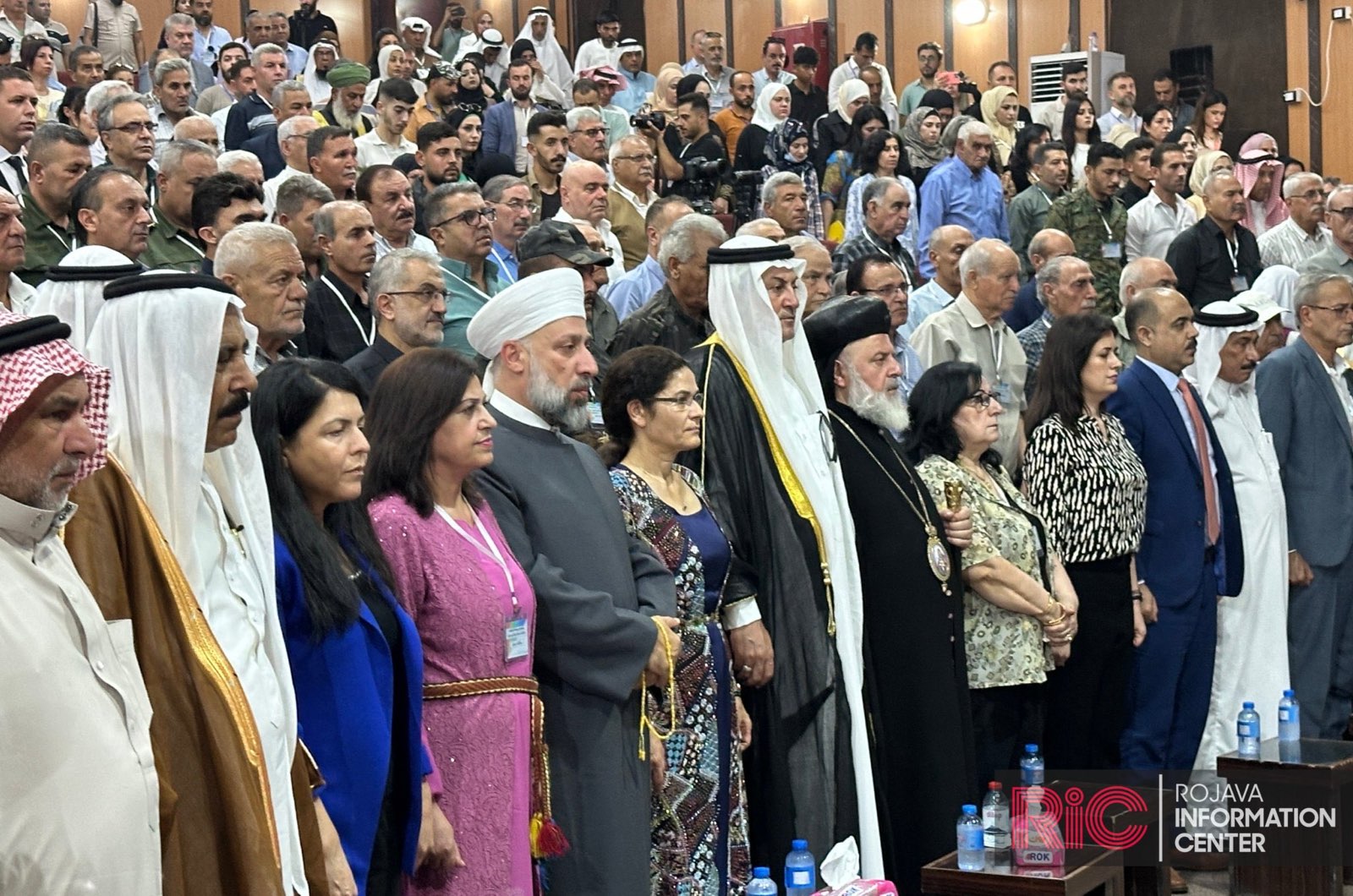
The question of the extent of formal protections and autonomy for minority communities including the Alawites, Druze and Kurds, plus the Christian and Yezidi minorities, is a key sticking-point in ongoing negotiations between NES and Damascus, as is the extent to which these protections will be guaranteed by a degree of military autonomy in NES or indeed in other regions of Syria.
THE TERROR THREAT: AN UNCERTAIN FUTURE
President al-Sharaa’s prior affiliation with al-Qaeda and long-term status as a listed terrorist have been well documented, including through RIC’s report on al-Sharaa’s attempts to distance himself and HTS from these other groups and present a more moderate image. These efforts notwithstanding, terrorism remains a threat in Syria and it is still unclear how effective al-Sharaa has been at distancing himself from jihadists like the foreign fighters he has integrated into the military and given leadership positions. The transitional government has also said it will commit to rooting out ISIS and join the Coalition on a political, though not a military basis, a step which risks angering and alienating elements of al-Sharaa’s base who remain fundamentally ideologically opposed to the US presence in the region.
In NES, the SDF is still partnered with the U.S. through the Global Coalition against ISIS and Operation Inherent Resolve. The SDF still holds around 9000 former ISIS fighters in its prisons and regularly undertakes operations to root out sleeper cells. The bulk of the work to combat ISIS will thus likely remain with the SDF, who have agreed that their elite anti-terror units can operate across the country as part of the integration into the rest of Syria, with the SDF’s long-term status as the main force capable of suppressing the terrorism threat in Syria as a formal partner of the US and its Western allies remaining a key factor guaranteeing NES’ continued survival. “In the new Syria, in addition to the SDF’s integration into the new Syrian army, our anti-terrorism forces will also play a role,” Mazloum Abdi has said.

RAPID REINTEGRATION: TURKEY, US AND ISRAEL IN THE NEW SYRIA
The three countries with a major military presence in Syria today are Turkey, the USA and Israel. Each has had a fraught relationship with the Syrian state in the past. During the civil war, Turkey and the USA both backed groups fighting al-Assad, and Israel sought to combat Iran’s influence in Syria through airstrikes.
Turkey has played an influential role in shaping the post-Assad Syria. Turkey was the first country to reestablish diplomatic relations with Syria. Al-Sharaa has received Turkish ministers on several occasions over the past year, met President Recep Tayyip Erdoğan in Cairo and made several visits to Istanbul. Beyond the economic opportunities presented by redevelopment and financial reintegration in Syria, Turkey sees Damascus as an important ally in neutralising the SDF. Turkey has retained its military bases in the Turkish-occupied cantons of the NES region and with its influence has been able to influence and disrupt negotiations between the transitional government and DAANES.
Meanwhile, the US maintains a presence in NES as part of the Coalition against ISIS and also maintains their position at al-Tanf military base near the Syrian-Iraqi-Jordanian border and the surrounding deconfliction zone. US representatives have announced they intend to reduce their presence in Syria, though Reuters reported the US military in fact intends to establish a presence at a Damascus airbase, a report subsequently denied in turn by US officials.
With relations between the US and Syria quickly thawing, there is the possibility that the US will abandon its long-term relationship with the SDF in favour of a new understanding with Damascus. Notably, US Special Envoy to Syria Tom Barrack has suggested that the proposals for a decentralized Syria should be abandoned, claiming “decentralization has never worked in this region,” in comments widely seen as calling for NES to return to effective control by Damascus.

Tel Aviv has moved to secure its own interests in the new Syria. Immediately following the fall of al-Assad, Israel announced it no longer recognised the 1974 ceasefire and invaded south-west Syria, expanding its control over the occupied Golan Heights to include the UN-administered demilitarized zone. The Israeli Defence Forces (IDF) have carried out operations further east of the demilitarized zone, killed, arrested and displaced civilians, shot at protestors, destroyed electricity and water networks, prevented farmers accessing their fields and built at least nine military outposts in the newly occupied land. Israel has also carried out hundreds of airstrikes on Syria in the last year. These have primarily been focused on military targets like military equipment and ammunition depots, although Israel has also launched air strikes on Damascus, Suwayda and Daraa, with Tel Aviv claiming it is seeking to protect the Druze population from government-affiliated forces. In public statements, Israel has adopted a supportive position towards NES and has generally supported a decentralised model for Syria, with the post-Assad period seeing instances of unprecedented contact between Tel Aviv and NES representatives, though there is no formal military or political relationship between the two. Any alignment with Israel runs the risk of distancing NES from the remainder of Syria, given broad public hostility to Israel’s policies and military operations in Gaza and Syria itself.
Conversely, Russia and Iran find themselves on the back foot in Syria following al-Assad’s demise. Its status as one of al-Assad’s strongest supporters notwithstanding, Russia still has a presence in Syria, including Russia’s only naval base in the Mediterranean at Tartous; Hmeimim Air Base; and a small presence in NES, at Qamislo airport. The status of Russia’s military bases is still being negotiated: “We are reorganising this relationship in line with Syrian interests,” said al-Shaibani. “If there is mutual benefit, we will proceed… But as things stand, they serve no purpose.” Meanwhile, Iran has fallen firmly out of favour with Syria’s new government. Where it once controlled 70% of the 830 military installations in Syria, there is now no official Iranian presence in Syria, and a ban has been placed on Iranian nationals and goods entering the country.
SANCTIONS, ECONOMY, RECONSTRUCTION: SHARED CHALLENGES
Having achieved a degree of legitimacy on the international stage and initially positive relationships with foreign states, alongside a somewhat stable internal political system and integrated military, the government is now setting its sights on rebuilding Syria. Since the civil war broke out in 2011, Syria’s GDP has halved and six million people have fled the country, largely from the most educated and wealthiest sections of society. A further seven million have been internally displaced, and 90% live below the poverty line. Conservative estimates from the World Bank suggest that the cost of reconstruction could be $216 billion, nearly ten times Syria’s projected 2024 GDP.
Gulf states have been the most prominent financial supporters. At the ninth Future Investment Initiative Institute conference in Riyadh, al-Sharaa announced that Syria has attracted $28 billion in foreign investment, the vast majority from companies based in the Gulf or consortiums led by companies based in the Gulf. Turkey has also made financial commitments in Syria, primarily through energy. Turkey will supply natural gas from Azerbaijan to Aleppo to increase the electricity supply, in a Qatari-financed scheme.
In Davos, al-Shibani pointed out that, “removing economic sanctions is the key for the stability of Syria.” Whilst billions of dollars have been pledged by foreign states, and corporations are eager to explore the new market opportunities in Syria they will be hesitant to let go of that money until sanctions are lifted. The U.K. has eased sanctions on Syria and this December published guidance for investors in the country. Meanwhile the EU has also eased sanctions and the U.S. has temporarily lifted the Caesar Act sanctions, and Congress looks set to permanently lift them later this month.
Representatives of the NES’ financial bodies have criticized rapid moves by the STG to introduce aggressive neoliberal reforms, including removing subsidies for basic essentials and cutting back social welfare payments, while opening the country up to direct private investment. Rather, they have called for the broad program of subsidies throughout NES (primarily focused on providing subsidized diesel and bread as well as supporting marginalized and at-risk members of the population) to inform a managed transition to a more open market, which retains social protections funded by Syria’s oil revenues.
NES has been affected by the same economic issues as the rest of Syria, including the diverse and long-term sanctions imposed on the country. Mazloum Abdi has been vocal in his support for lifting the sanctions. Last May Abdi posted on X, “We thank U.S. President Donald Trump (@POTUS) for halting the sanctions on Syria, a step that will positively impact the country. We hope this move supports stability and reconstruction for a better future for all Syrians. Syria deserves the best.” However, Abdi has also recently stressed that lifting the sanctions and support from the US “needs to be conditional. US support must not be unconditional. At the moment, there are no conditions on [Syria’s interim President] Ahmed al-Sharaa.”
The current version of the National Defense Authorization Act expected to pass in Congress later this month stipulates that the White House must monitor whether the Syrian government takes steps to combat ISIS and other terrorist groups, uphold the rights of religious and ethnic minorities, not take unilateral military action against Israel and take steps to implement the March 10 agreement among other conditions. Failure to do this could mean the US President chooses to reimpose sanctions.
NES, like the rest of Syria, is in need of investment to rebuild and meet the humanitarian challenges faced by its population. The Tishreen Dam has been damaged from Turkey’s bombing, while the crucial Alouk water station in Heseke has long been kept from functioning due to its control by Turkish-backed factions, creating a severe water crisis which the UN estimates is affecting direct access to water for 460,000 people in NES. The STG also closed its internal border crossings with NES in October 2025, creating an immediate negative effect on trade, commerce and productivity in the region. Alongside this development, the transitional government stopped buying NES oil in November, cutting a vital source of revenue for DAANES which gets around 75% of its income through oil. However, the DAANES appear to have rerouted their crude oil to the Kurdistan Region of Iraq (KRI) through a repurposed short pipeline, leaving NES economically reliant on a government allied with Turkey.

Officials in NES have stated that the unstable security situation, restrictions on the free trade of goods and services and a lack of official recognition of DAANES have deterred foreign investors. However, the lack of substantial capital in NES means foreign investment is essential to any significant economic activity in NES, meaning the region must overcome both its internal isolation within Syria and Syria’s broader economic isolation if it is to redevelop further.
Until Syria’s economy has been revived, the country will remain reliant on foreign aid. In the last year however, aid experts estimate that roughly $237 million in U.S. aid was cut. Furthermore, the UN has sought to centralise its operations in Damascus instead of its previous model, which was more distributed across Syria, though still unevenly. Amid an ongoing drought and medicine shortages these cuts and the UN’s ongoing restructuring have caused some operations to stop or slow down. These developments have prevented people across Syria from getting the aid they need, a situation which has hit NES particularly hard. Human Rights Watch reported that NGOs are having difficulty in getting “approvals for registration”, while facing “harassment and threats. Aid workers said the government required aid delivery through the Syrian Arab Red Crescent and cited bureaucratic delays.”
CONCLUSION
The developments since al-Assad was ousted from power and al-Sharaa rose to rule Syria have brought benefits and relief to millions of people across Syria and in NES. Despite outbreaks of violence then Al-Sharaa has thus far prevented the country from descending into further civil war; sanctions are in the process of being lifted; and billions of dollars are potentially being invested into rebuilding Syria after 14 years of war. But at the beginning of al-Sharaa’s second year in power, the situation in Syria looks fragile. The successes of the transitional government have been overshadowed by sectarian violence, alongside massacres and exclusion of minorities and women from shaping the new Syria, and aggressive neoliberal reforms threatening the sustenance of millions of Syrians. In this context, it is unsurprising that many political representatives and private individuals in NES, particularly women and members of minority communities, are sceptical about the benefits that can be offered by integration with a new government.
If the end of 2024 brought fresh hope and new fears to millions in NES, the end of 2025 sees the region still standing at the crossroads. Both Damascus and NES appear eager to avoid fresh conflict, creating room for the ongoing negotiations which could potentially see 2026 become the year of Syrian reunification. However, whether this pragmatic desire to evade conflict can be parlayed into a genuinely sustainable settlement remains to be seen throughout the year ahead.